

The meeting room is one of the most heavily used and most frequently misdesigned spaces in the modern office. It is asked to do more than ever before — host hybrid video calls, support focused thinking, accommodate one-to-one conversations, and provide a client-ready environment at short notice. Yet in many fitouts, it is designed last, specified generically, and delivered without any real consideration of how it will actually be used.
The result is familiar: rooms that echo, screens positioned at the wrong height, lighting that flattens faces on camera, and furniture that cannot be reconfigured when the brief changes. These are not minor irritations. They affect how decisions are made, how teams collaborate, and how your organisation presents itself to the people who visit it.
Good meeting room design is not complicated — but it does require deliberate choices made early, before the ceiling goes in and the AV is specified. This guide sets out what those choices are, and why they matter.
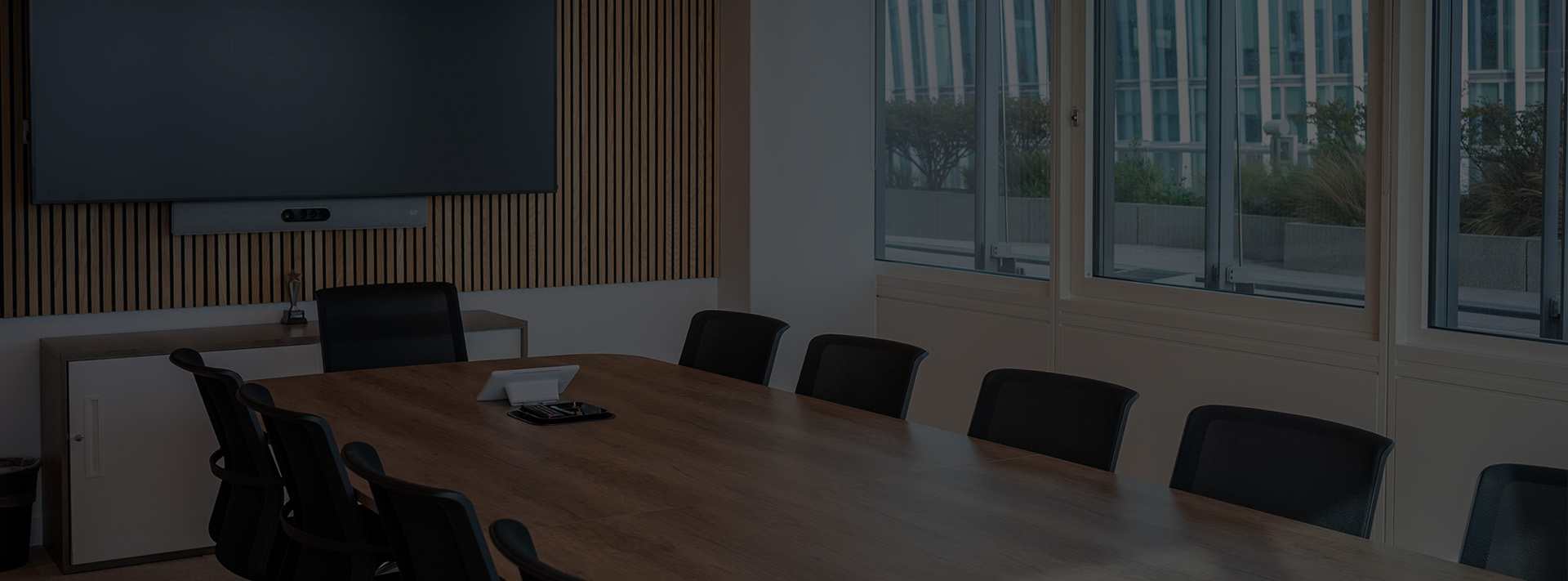
A meeting room that looks right in a render but performs poorly in use is one of the most common and avoidable outcomes in office fitout.
Start with how meetings actually happen in your organisation
Before a single room is designed, it is worth understanding what kind of meetings take place in your organisation and how often. A business where most collaboration happens in pairs and small groups needs a fundamentally different mix of rooms than one where large team briefings are the norm.
The most useful framework is to think in terms of four meeting types: the quick catch-up (two to four people, informal, often unplanned), the working session (four to eight people, longer, often requiring shared screens or writable surfaces), the formal meeting (eight or more, structured, often client-facing), and the hybrid call (any size, but with at least one remote participant). Each has different spatial, acoustic, and technology requirements — and designing a single room type that tries to serve all four will serve none of them particularly well.
A well-designed meeting suite gives people a genuine choice of environment. The brief for that suite starts not with room sizes and screen specifications, but with an honest count of which meeting types happen most often and what each of them actually needs.
Most well-executed biophilic fitouts incorporate elements of all three. The balance depends on the space, the budget, and the specific outcomes the organisation wants to achieve.
The four design principles that determine whether a meeting room works
1. Acoustic performance comes first
A meeting room can have excellent technology, well-specified furniture, and high-quality finishes — and still fail completely if the acoustics are wrong. Acoustic performance in meeting rooms has two distinct dimensions: how the room sounds internally (reverberation, speech intelligibility, echo), and how well it contains sound from adjacent spaces (speech privacy).
Hard surfaces — exposed concrete, glass partitioning, polished floors — reflect sound and increase reverberation. For a room used primarily for conversation, a reverberation time above 0.6 seconds starts to affect speech clarity noticeably. The fix is absorption: ceiling treatment, upholstered furniture, fabric wall panels, and soft flooring. These are not compromises on aesthetics — they are the specification decisions that determine whether the room sounds as good as it looks.
Speech privacy — the ability to have a confidential conversation without it being overheard outside the room — is a separate issue, governed by the mass and sealing of the partition system rather than the internal acoustic treatment. Full-height partitions sealed at head and floor, with acoustic seals on door frames, are the baseline for any room where confidential conversations will take place.
2. Lighting needs to work for people and for cameras
Meeting room lighting is one of the most frequently under-specified elements of a fitout. The standard approach — recessed downlights on a dimmer — creates problems that only become apparent when the room is in use: faces lit from above look harsh on camera, screens wash out in brighter settings, and the overall ambience shifts uncomfortably between ‘boardroom presentation’ and ‘interrogation room’ depending on what the dimmer is set to.
Lighting designed for meeting rooms works in layers. Ambient light provides the base level and should be even and diffuse rather than directional. Vertical illumination — light directed at faces from the front rather than above — is what makes people look natural on a video call. Task lighting addresses specific needs such as note-taking at a table. And tunable white systems, which allow colour temperature to shift from warm to cool, give the room the flexibility to support different meeting types and times of day without requiring separate circuits.
The practical specification decision is where to locate the primary light sources relative to the camera position. In a room used regularly for hybrid calls, frontal diffuse light at approximately 30 to 45 degrees from the subject is what produces natural facial rendering on screen. Designing for this from the outset is straightforward. Retrofitting it after the ceiling is plastered is expensive.
3. Technology should disappear into the room
The best meeting room technology is the kind that works reliably without anyone having to think about it. A single cable that connects a laptop to the screen and the room’s audio system. A camera that automatically frames the people in the room. Controls that are immediately intuitive without a laminated instruction sheet on the table.
Achieving this requires technology decisions to be made during the design phase, not after. Cable management, screen positioning, camera placement, microphone arrays, and control system routing all have implications for the structure of the room — for where conduit runs, where ceiling tiles are positioned, and where wall boxes are located. A room where technology has been designed in from the start looks clean and functions smoothly. A room where it has been retrofitted looks messy and frustrates the people who use it.
Screen sizing is a particular area where decisions made on paper do not always translate to the room. The readable distance for content on a screen is directly related to the screen size and the resolution of what is being displayed. In a room where people will regularly be reading text from a presentation, the screen needs to be large enough for the person at the far end of the table to read it without leaning forward. This calculation should be done for the specific room dimensions during design, not after a standard-size screen has been ordered.
4. Furniture determines how the room is actually used
Fixed furniture is the enemy of a flexible meeting room. A large fixed table in a room that is also used for one-to-one conversations means one person sits at a table designed for twelve. A non-reconfigurable layout cannot adapt when a team needs to brainstorm rather than present.
The furniture brief for a meeting room should follow from the meeting types identified at the outset. A room used primarily for working sessions benefits from modular tables that can be pushed together or separated, writable wall surfaces, and chairs that are easy to move. A formal boardroom has different requirements: a fixed table that conveys authority, high-quality seating that signals investment, and an environment that reflects the organisation’s brand rather than a generic supplier catalogue.
One consistent principle applies across all types: people should be able to move freely around the room without navigating obstacles. The minimum circulation space around a table — the gap between the chair when occupied and the wall behind it — should be at least 1.2 metres. In practice, many meeting rooms are designed with circulation gaps below this, and the result is a room that feels cramped from the first day of occupation.
This isn’t a soft benefit. For organisations where cognitive performance, creativity and sustained concentration are commercially significant — which is most of them — the design of the environment is a performance variable.
The meeting room that works best is not the one with the most technology. It is the one where the acoustics, lighting, furniture and technology have been designed together, for the specific kind of work that will happen in it.
Meeting room typologies: matching the room to the meeting
A well-planned meeting suite contains a mix of room types rather than replicating the same specification at different scales. The following typologies represent the core range for most organisations:
Huddle spaces (two to four people) work best as informal, semi-enclosed zones rather than fully enclosed rooms. High-backed seating, a small screen for sharing content, and acoustic treatment that contains conversation without requiring a full partition system. These should be distributed across the floorplate rather than consolidated in one area, so that they are genuinely accessible and genuinely used.
Working rooms (four to eight people) are the workhorse of most office environments. The specification should prioritise flexibility: tables that reconfigure, writable surfaces for working through problems, good hybrid call capability, and acoustic performance that supports both structured discussion and informal exchange. This is typically the room type that is most underspecified in fitouts and most complained about post-occupation.
Formal meeting rooms and boardrooms (eight or more people) require a higher level of finish and a more resolved approach to brand environment. These are rooms where the organisation is judged by the people who visit them — clients, investors, candidates. The furniture, lighting, and acoustic specification should reflect that.
Common mistakes and how to avoid them
The mistakes we encounter most often in meeting room design are consistent across projects and sectors. Acoustic treatment is added as an afterthought — a few panels chosen from a supplier brochure after the room is built — rather than designed into the specification from the start. Lighting is specified as a single circuit without consideration of how the room will be used for hybrid calls. Technology is ordered to a budget rather than to the room dimensions. Furniture is selected for visual impact rather than functional flexibility.
The underlying cause is almost always the same: meeting room specification is treated as a late-stage decision rather than an early-stage design question. By the time rooms are being fitted out, the structural and service decisions that would have enabled better performance have already been made. What remains is a choice between good and good enough, rather than between good and excellent.
The way to avoid this is to bring the meeting room brief into the design conversation early — not as a room-by-room schedule of finishes, but as a description of what the room needs to do and what a successful outcome looks like. That brief drives better decisions at every stage that follows.